
My first cow was a Red Devon called Hannibal. She was a looker, and she knew it – boxy with a straight back, a deep red-brown coat, and tight curls on her forehead and forequarters. She behaved like a supermodel – stubborn at a threshold, flouncing through tall grass, always showing her best side.
All our cows had personalities. Molly was our lead cow, first out of the gate. Aileen invariably brought up the rear. And Number 23, whose given name didn’t stick, was our nanny cow, always surrounded by a posse of calves. Bella was the first calf born on our farm. I have a photograph of our son, Inigo, feeding her. He is five years old. He’s holding on to the milk bottle with both hands, determinedly, and Bella has latched on to the teat and is rolling her eyes in pleasure at the warm milk.
Cows were domesticated in neolithic times, or earlier, so we’ve all grown up together. Humans have long relied on cattle as a store of value; as early as 9000 BC they were used as money or for barter – our “first currency”. They have provided us with transport, and company, as well as meat, milk and manure. They feature in our nursery rhymes, our songs, our stories, our myths … and our poems.
I learned Edmund Vance Cooke’s ‘The Moo Cow Moo’ as a child, and recited Robert Louis Stevenson’s ‘The Cow’ at school. Jim Carruth’s ‘Herd’ takes me back to our farm, sending our kelpie sheepdog out on cold mornings to bring in the cows. Tjawangwa Dema emphasises the spiritual aspect of the cow – hers is a “wet-nosed god”. In a field or on the page, chomping grass or symbolic of wealth, generosity, and serenity, the cow is fundamental to all our lives.
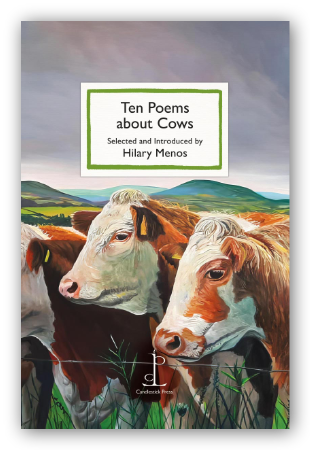
For Ten Poems about Cows I chose poems by Hayden Carruth, Jim Carruth, Gillian Clarke, Edmund Vance Cooke, Ruth Dallas, Tjawangwa Dema, Selima Hill, Gill Smith and Robert Louis Stevenson, and added one of my own, ‘Transhumance’.
Transhumance
Driving through the Pyrenees one June
before marriage, before children, before sat nav, even,
we left caution and the map behind, took an unsigned turn
and found ourselves on an ancient drovers’ lane
in a ruck of cows up from the Spanish canyons,
all colours from blanche to brass, from butter to bronze,
ambling, then pausing to tug at wild thyme and houseleek
on the trek to summer grazing in the French cirques.
No drover in sight, no guide, just one rough guard –
a mountain shepherd dog trotting alongside.
On this age-old track some sixty miles from Pau
you watched the cattle pass, and I watched you
and reckoned our romance. Such paths appear
on no man’s map or chart. Yet here we are.